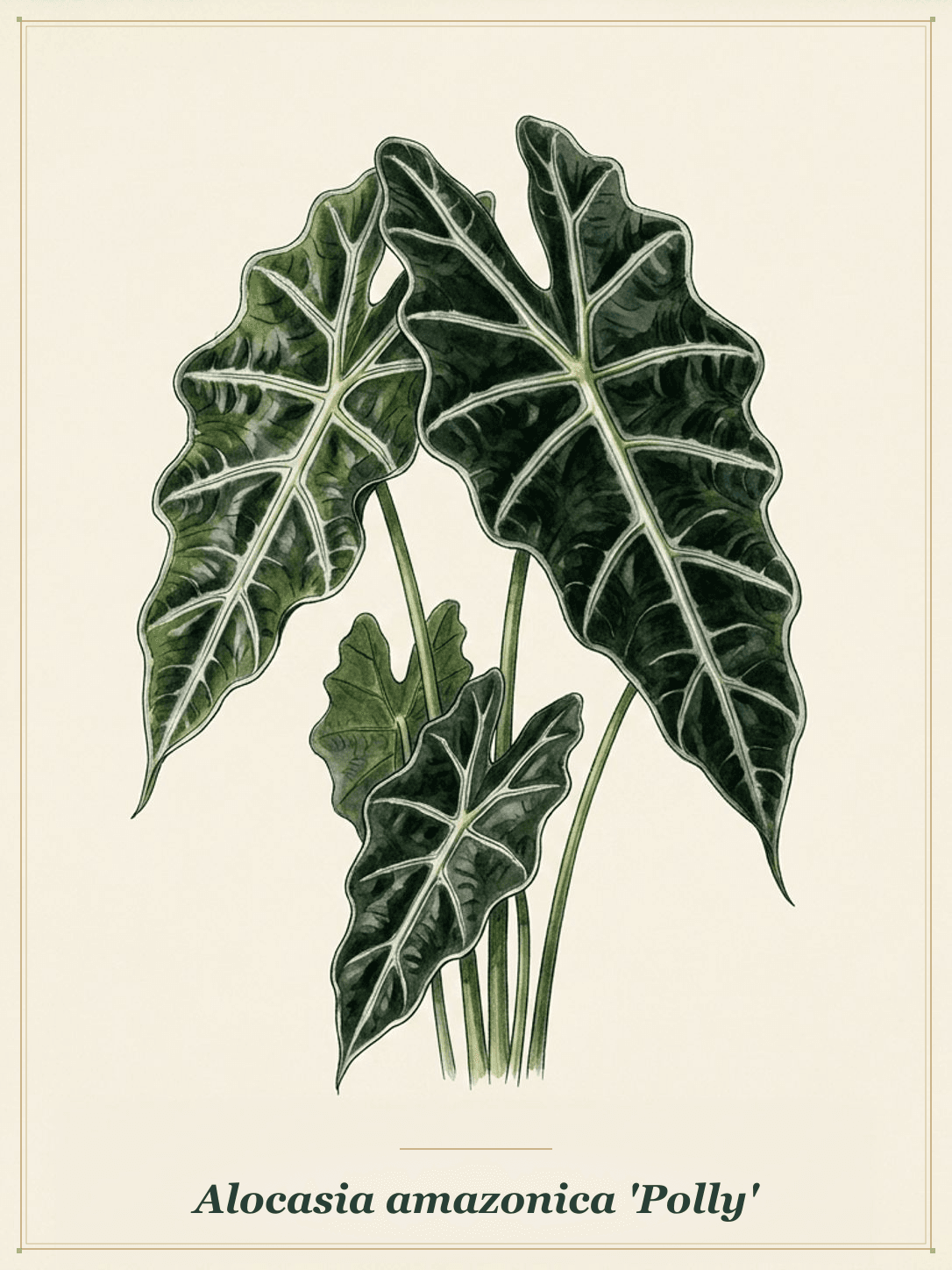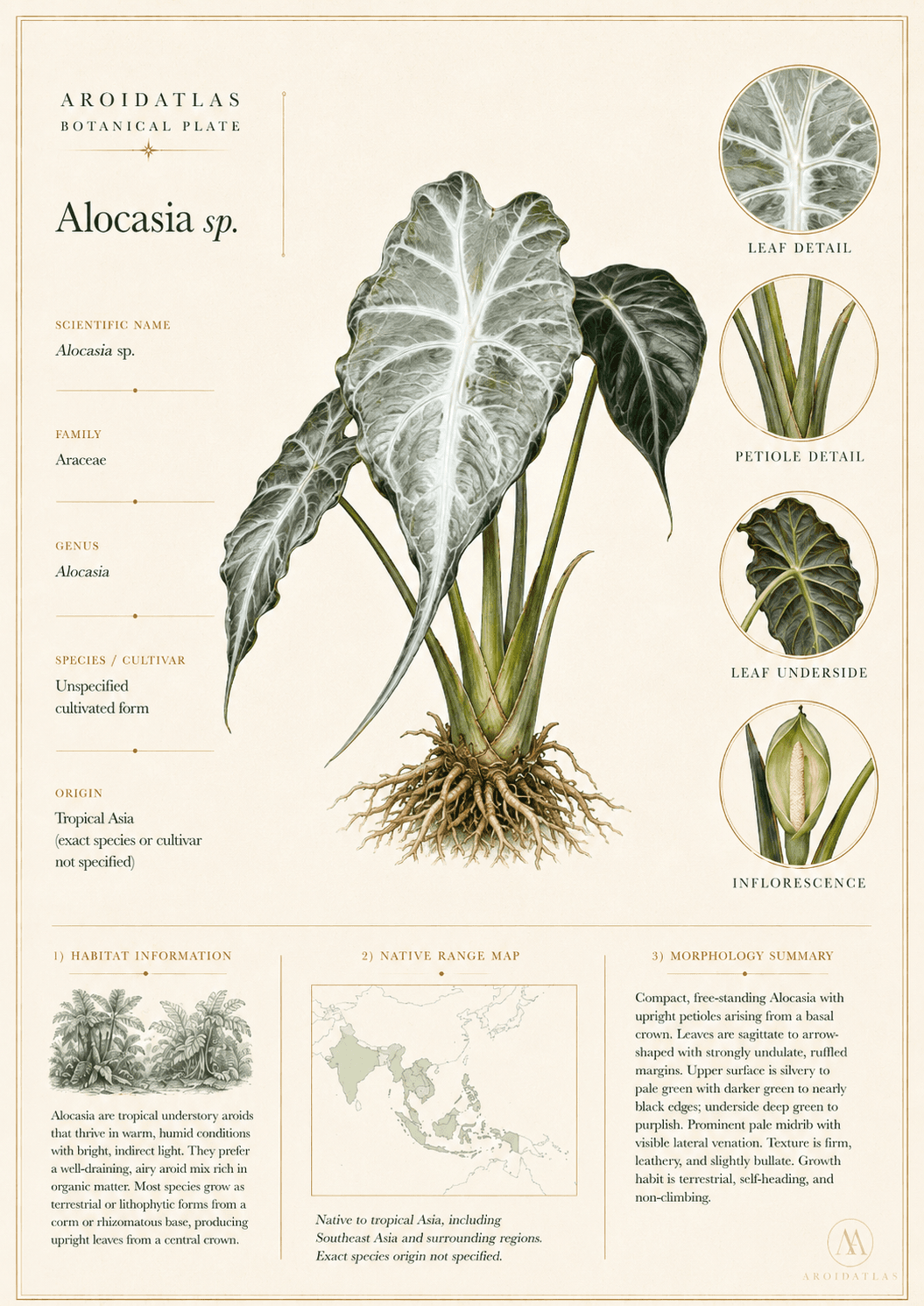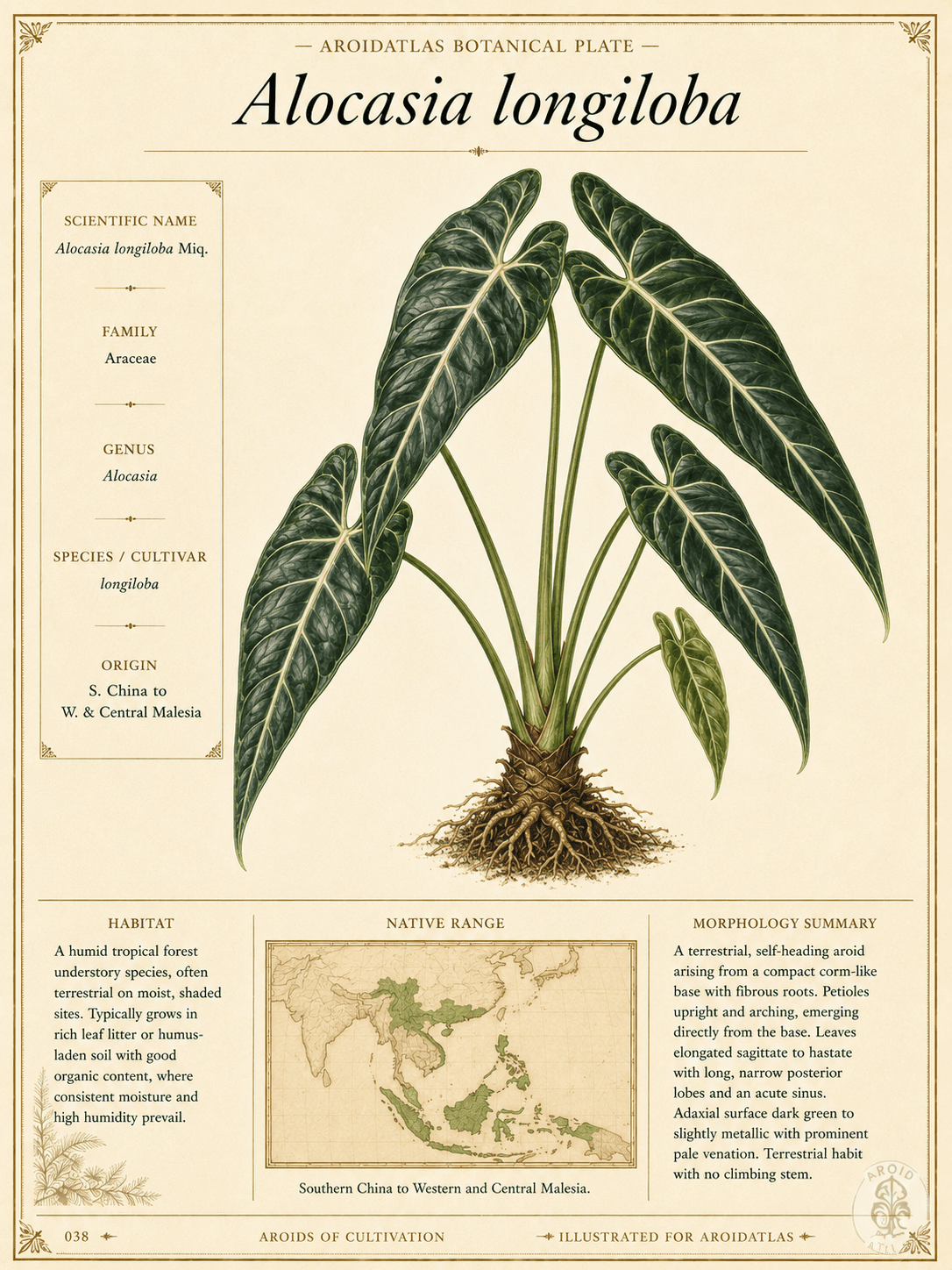
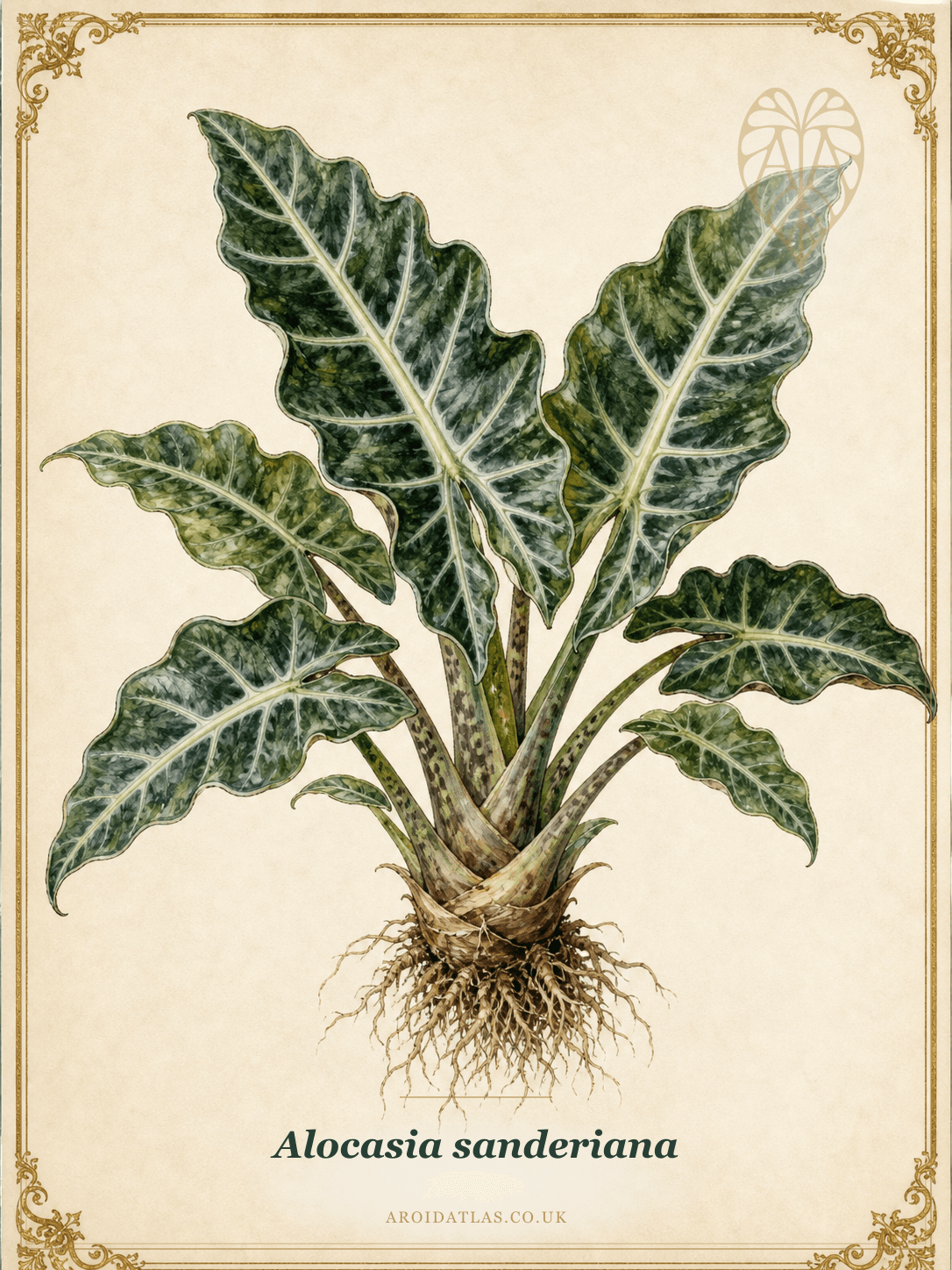
A horticultural cross — priced, illustrated and tracked independently of either parent. Sources disagree on the exact cross; see the field notes below.
Sources:Aroidpedia — Alocasia 'Amazonica' ·The Alocasia Company — Amazonica: The Legend Hybrid
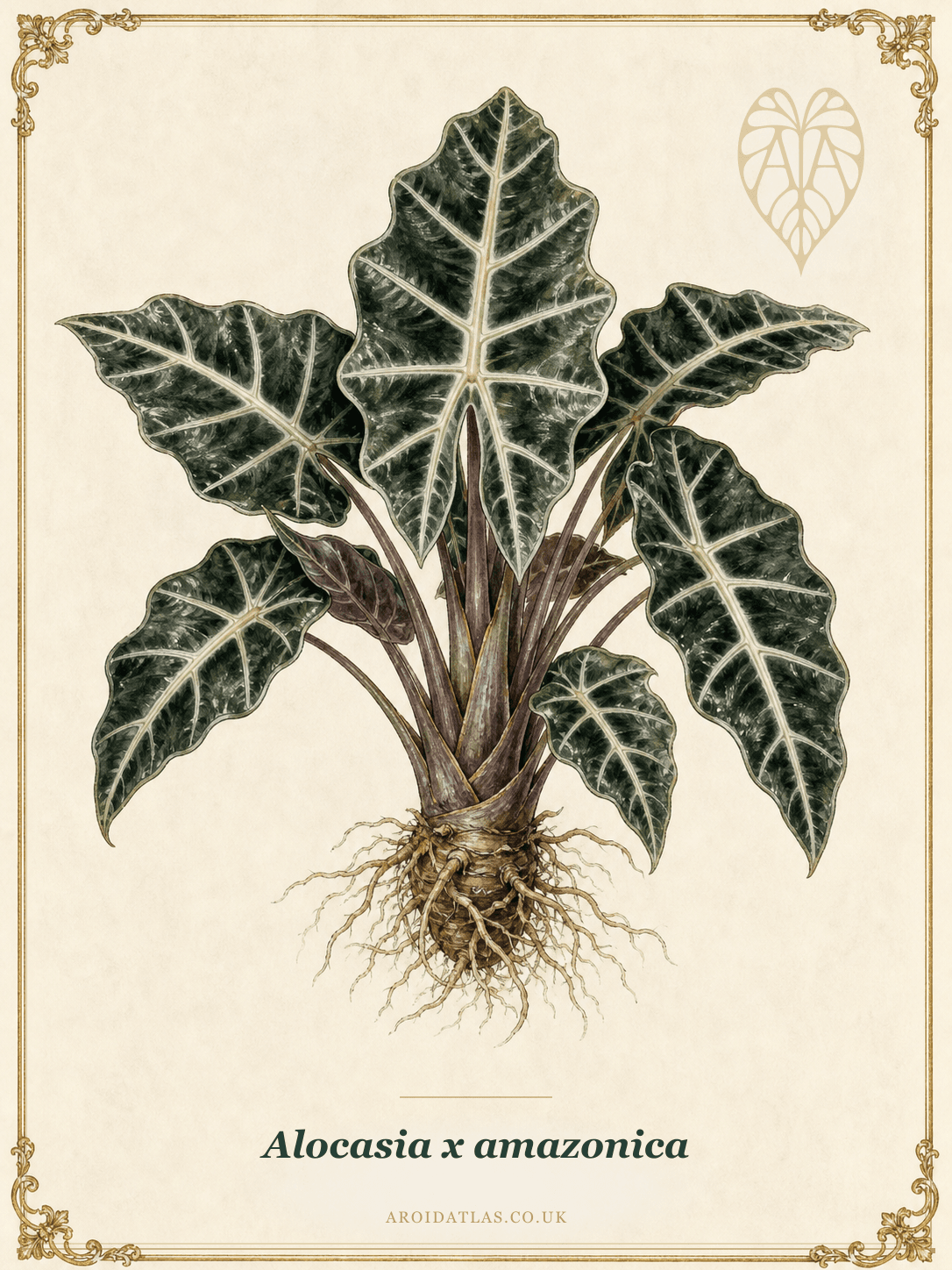
Full Specimen Plate
Alocasia × amazonica
Amazonica Hybrid
Quick Facts
Aroid Atlas Price Guide
Community estimate — limited market data
See full auction data ↓Morphology
About
Alocasia × amazonica is one of the most widely recognised aroid hybrids, its glossy near-black, deeply-veined arrow-shaped leaves a fixture of houseplant shops for decades — despite a name that misleadingly suggests Amazonian origin. It is almost universally credited to Salvadore Mauro's Florida nursery in the 1950s as a cross between Alocasia longiloba and Alocasia sanderiana, though the exact breeding history is not formally documented and some accounts differ on the details. This single cross has since produced a whole family of named sports and selections — 'Polly' (a compact tissue-culture mutant), 'Bambino' (dwarf), and 'Venom' (a further mutation of the line with dramatically thickened, corrugated leaves) among them — all propagated vegetatively rather than resulting from further deliberate crosses.
Native Range
Florida, USA
Collector Popularity Review
Aroid Atlas Collector Review: Alocasia × amazonica (Amazonica Hybrid) is ranked as Common rarity on the market. Rating is calculated based on overall cultivation difficulty, aesthetic appeal, and search popularity among active collectors.
Market Analysis
Auction History & Retail Data
Historical eBay auction metrics and live retailer listings updated weekly.
No eBay auction history available yet. Data is collected automatically as sales appear on eBay UK.
Before You Buy
Species-specific things to check when evaluating a listing
- Widely available and inexpensive — be cautious of pricing that implies rarity for the plain hybrid
- For named sports (Polly, Bambino, Venom), confirm the leaf texture/size matches the specific named form
- Check the corm/base is firm, not soft or foul-smelling
Propagation Guide
Growing More Plants
2-3 months
Cultivar character is preserved through vegetative cuttings
Produces basal offsets readily, propagated by division rather than seed — the named sports (Polly, Bambino, Venom) are all maintained through vegetative propagation/tissue culture to preserve their distinct mutations.
Care Guide
Growing Conditions
Chunky, fast-draining aroid mix: 40% orchid bark, 30% perlite, 20% potting compost, 10% charcoal.
Allow the top 2-3cm of substrate to dry between waterings. Reduce in winter.
60-80%.
Balanced liquid fertiliser at quarter to half strength every 3-4 weeks during active growth.
Every 12-18 months, or when offsets crowd the pot.
Common Problems
Sudden leaf loss / dormancy
Natural seasonal response
Reduce watering and wait for new growth in spring
Root/corm rot
Overwatering combined with dense substrate
Repot into fresh dry chunky mix and reduce watering
Spider mites
Low humidity and still air
Increase humidity and treat with insecticidal soap
The Legend, As Best I Can Tell It
Every source agrees Alocasia × amazonica is a hybrid, and nearly all of them name Salvadore Mauro's Florida nursery in the 1950s and the same two parent species — longiloba and sanderiana. Where accounts start to diverge is the finer detail: exactly which named forms count as the 'original' cross versus later independent re-creations of the same pairing, and how much of the plant's later history (Polly, Bambino, Venom, and others) was one continuous breeding line versus several separate discoveries that all converged on a very similar-looking plant. I've recorded the parentage that every source I found agrees on and flagged it as debated rather than pretend the finer points are settled.