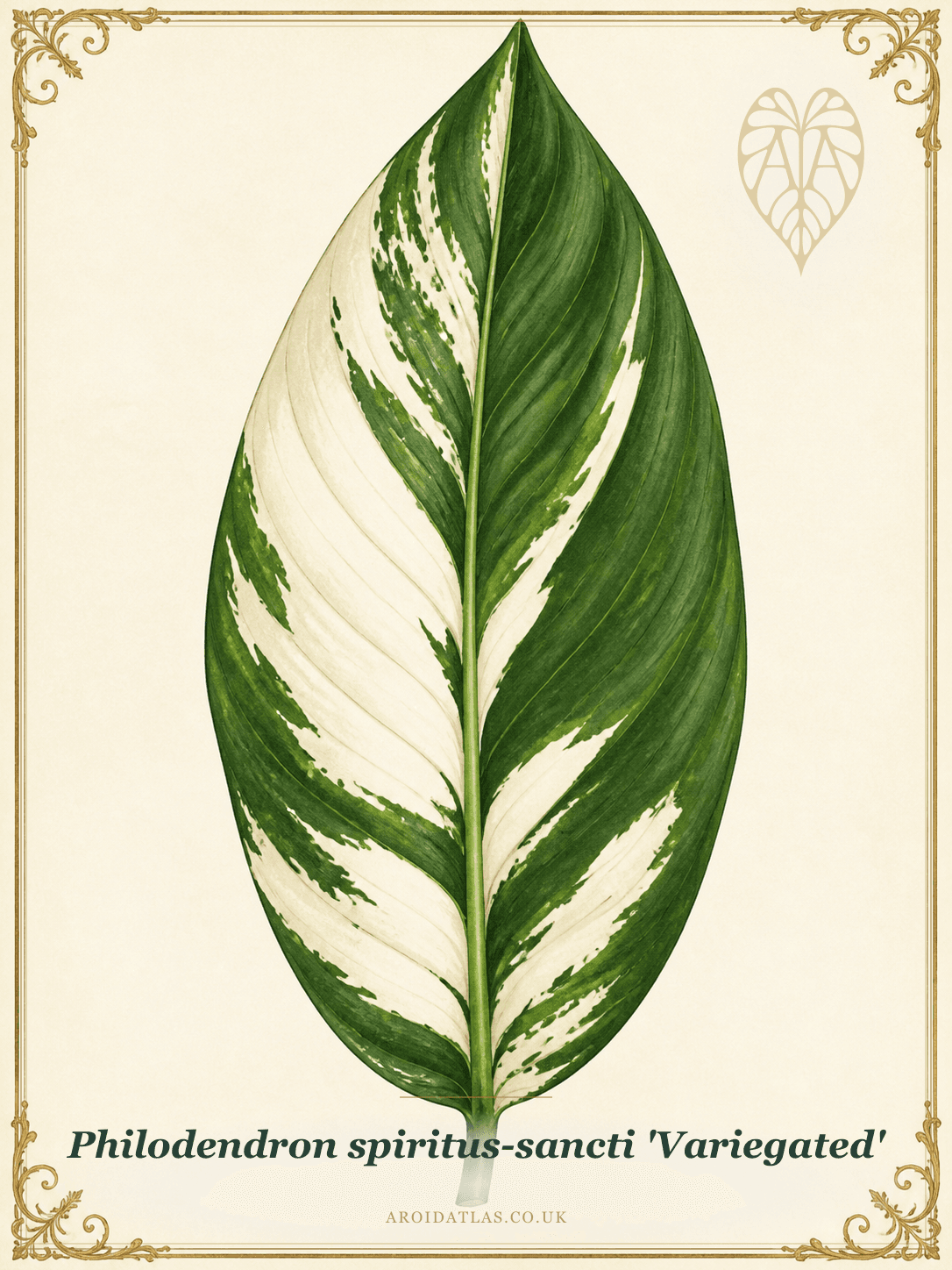
Leaf Detail Portrait
Philodendron spiritus-sancti 'Variegated'
Variegated Holy Spirit Philodendron
Quick Facts
Morphology
About
Philodendron spiritus-sancti is already one of the most coveted species in the genus — critically endangered in the wild, known from a single Brazilian ravine — and its variegated sport pushes that scarcity further still. Striking irregular variegation sectors interrupt the elongated, lanceolate leaves that make the plain species so distinctive, with expression varying considerably between individual plants and even between leaves on the same specimen. Growth is slow even by spiritus-sancti standards, and reduced chlorophyll on variegated sectors means it demands strong, consistent light to avoid stalling out entirely.
Market Analysis
Auction History & Retail Data
Historical eBay auction metrics and live retailer listings updated weekly.
No eBay auction history available yet. Data is collected automatically as sales appear on eBay UK.
Before You Buy
Shared checklist for Philodendron spiritus-sancti and its cultivated forms
- Check that roots are firm and white to tan — avoid plants with black, slimy, or absent roots
- Inspect leaf undersides for thrips (tiny dark specks or silvery streaking) and mealybugs (white cottony deposits at leaf axils)
- Verify the plant has at least 2–3 healthy leaves and shows signs of active growth
- For listings showing only one photo, request images of the roots, underside of leaves, and any new growth before purchasing
Propagation Guide
Growing More Plants
Shared across every form of Philodendron spiritus-sancti — see this form's own Morphology for variegation-specific propagation notes.
Slow-growing species that roots reluctantly. Use moist sphagnum with high humidity and bottom heat. Multiple nodes improve success. Valuable enough that air layering is often preferred to avoid losing the cutting.
Care Guide
Growing Conditions
General care shared across all forms of Philodendron spiritus-sancti — cultivated forms may need brighter light or higher humidity than the plain species; check this form's Quick Facts above.
High-porosity mix: 50% perlite, 30% orchid bark, 20% coco coir. Good aeration is essential — philodendrons are prone to root rot in dense substrates.
Water thoroughly when the top 3–4 cm of substrate is dry. Ensure free drainage and never allow to sit in water. Reduce frequency in winter.
60–80% preferred. UK tap water can cause brown tips — use rainwater or filtered water where possible.
Balanced liquid fertiliser (e.g. 20-20-20) at quarter strength every two weeks in spring and summer. Monthly at most in winter.
Every 12–18 months or when roots circle the base of the pot. Move up one pot size only — oversized pots increase rot risk.
Common Problems
Brown leaf tips
Low humidity or fluoride/chlorine in tap water
Increase ambient humidity and switch to rainwater or filtered water
Yellow leaves
Overwatering or compacted substrate
Allow substrate to dry further between waterings; check root health and repot if necessary
Leggy growth with small leaves
Insufficient light
Move to a brighter position with more indirect light