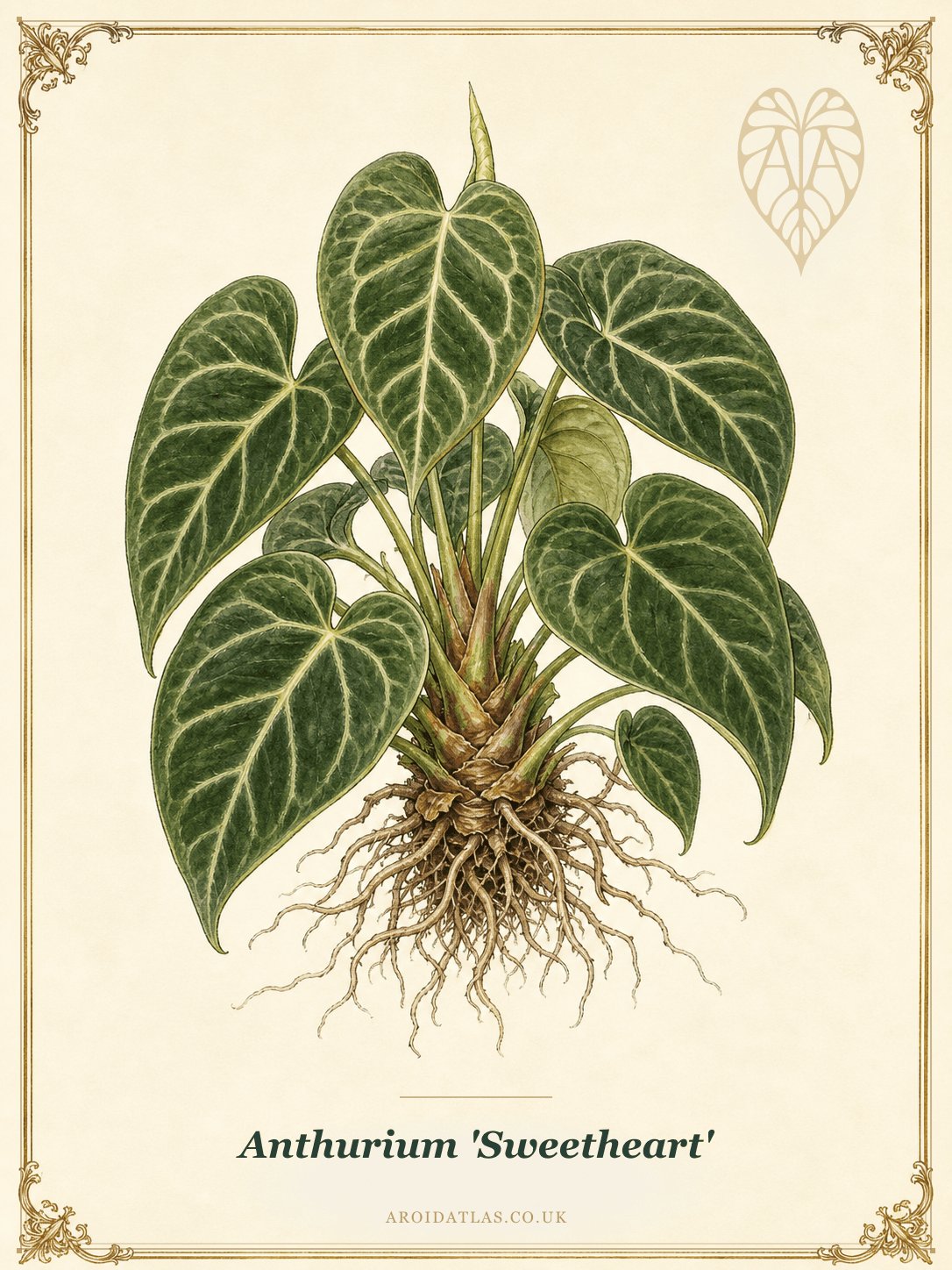
Full Specimen Plate
Anthurium 'Sweetheart'
Sweetheart Anthurium
Quick Facts
Morphology
About
Anthurium 'Sweetheart' takes its name from the perfectly heart-shaped, glossy pink spathe that sits atop a slender curling spadix, making it a favourite gift plant as much as a houseplant. Its broad, deep green leaves share the same heart-shaped outline as the blooms, giving the whole plant a cohesive, romantic silhouette. It flowers reliably indoors given consistent warmth and bright indirect light, and its compact size suits smaller collections and desk or windowsill display far better than the larger species-type Anthuriums.
Native Range
Colombia
Collector Popularity Review
Aroid Atlas Collector Review: Anthurium andraeanum 'Sweetheart' (Sweetheart Anthurium) is ranked as Common rarity on the market. Rating is calculated based on overall cultivation difficulty, aesthetic appeal, and search popularity among active collectors.
Market Analysis
Auction History & Retail Data
Historical eBay auction metrics and live retailer listings updated weekly.
No eBay auction history available yet. Data is collected automatically as sales appear on eBay UK.
Before You Buy
Shared checklist for Anthurium andraeanum and its cultivated forms
- Check the spathe (flower) is firm and unblemished — bruised or browning spathes indicate rough handling in transit
- Look for firm, pale roots visible at drainage holes — dark, mushy roots suggest rot
- This species and its common flowering cultivars should be inexpensive — be cautious of pricing that suggests rarity for a genuinely common plant
- New leaves should emerge glossy and unblemished; thrips damage shows as silvery streaking on the newest growth
Propagation Guide
Growing More Plants
Shared across every form of Anthurium andraeanum — see this form's own Morphology for variegation-specific propagation notes.
2-4 months
Cultivar character is preserved through vegetative cuttings
Flowering Anthuriums are far more forgiving to propagate than velvet-leaf species — basal offsets and stem cuttings root readily in a warm, humid environment. Named flowering cultivars are stable and propagate true from division.
Care Guide
Growing Conditions
General care shared across all forms of Anthurium andraeanum — cultivated forms may need brighter light or higher humidity than the plain species; check this form's Quick Facts above.
Chunky, well-aerated mix: 40% orchid bark, 30% perlite, 20% potting compost, 10% sphagnum moss — good drainage prevents root rot.
Water when the top few centimetres of substrate are dry. Consistent moisture supports continuous flowering, but avoid waterlogging.
50-70%. Tolerates average household humidity far better than velvet-leaf Anthurium species, making it a good entry point into the genus.
Balanced liquid fertiliser at half strength every 3-4 weeks; a phosphorus-leaning feed can encourage more prolific flowering.
Every 12-18 months, or when roots fill the pot. Prefers being slightly snug rather than heavily over-potted.
Common Problems
Reduced flowering
Insufficient light or lack of feeding
Move to a brighter spot with indirect light and resume a regular feeding schedule during the growing season
Yellowing leaves
Overwatering or poor drainage
Check roots for rot, repot into fresh chunky substrate if needed, and reduce watering frequency
Bacterial blight (leaf spotting)
High humidity combined with poor air circulation and wet foliage
Avoid overhead watering, improve airflow, and remove affected leaves promptly