Alocasia zebrina
Zebra Alocasia
Morphology
About
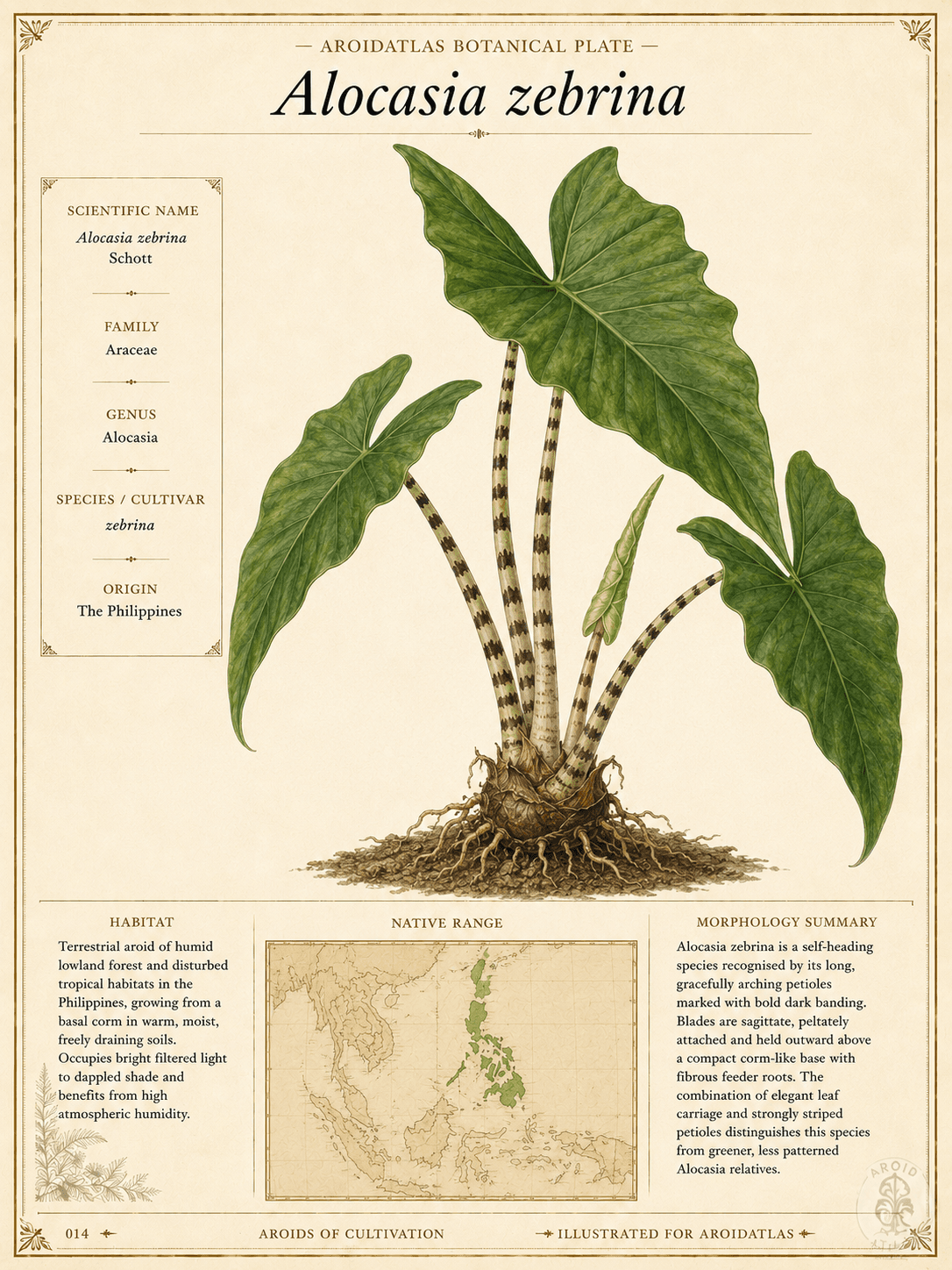
Alocasia zebrina is a terrestrial aroid native to the humid lowland forests of the Philippines, grown almost exclusively for its extraordinary petioles rather than its leaf blades. Those elongated stems are a natural marvel — pale yellow-green barred with irregular dark brownish-purple to near-black bands, mimicking the stripes of a zebra with uncanny precision. The broad, sagittate leaves emerge held upright and outward from a compact corm-like base, giving the plant a sculptural, palm-like silhouette at maturity. Among aroids, zebrina occupies a unique niche: dramatic enough to anchor a collection but forgiving enough to grow well in most warm, bright interiors.
Climate Profile
Market Analysis & Price Guide
Historical auction metrics and live online retailer listings updated weekly.
How prices are calculated: The AA Price uses verified eBay UK completed auction data — we take the trimmed mean (removing the top and bottom 20% of prices) to produce a fair-value guide that excludes outlier sales. When recent auction data is unavailable, the AA Price falls back to the current UK retail average from tracked stockists. Retail prices are scraped from active UK plant shop listings and reflect what you would pay buying directly from a retailer today. All prices are in GBP and updated automatically.
No eBay auction history available yet for this plant. Data is collected automatically as sales appear on eBay UK.
Stripes Without the Fuss
One doesn't always need to spend a small fortune to acquire something genuinely extraordinary. *Alocasia zebrina* proves the point rather elegantly. Those petioles — banded in ochre and near-black like some improbable tropical insect — are the sort of thing that stops visitors mid-sentence. The leaf blades themselves are perfectly respectable, broad and sagittate, but it is the stems that command the room. Native to the Philippines, this species has the considerable virtue of being relatively obliging in cultivation: bright indirect light, good humidity, a free-draining mix and occasional watering when the top third of the medium dries. It sulks if overwatered, as all Alocasias will, and it will drop leaves in winter if temperatures dip too sharply. But reward it with warmth and it pushes new growth with admirable regularity. A sound investment for the new collector, and a reliable talking point for the seasoned one.