Alocasia melo
Rugosa Jewel Alocasia
Morphology
About
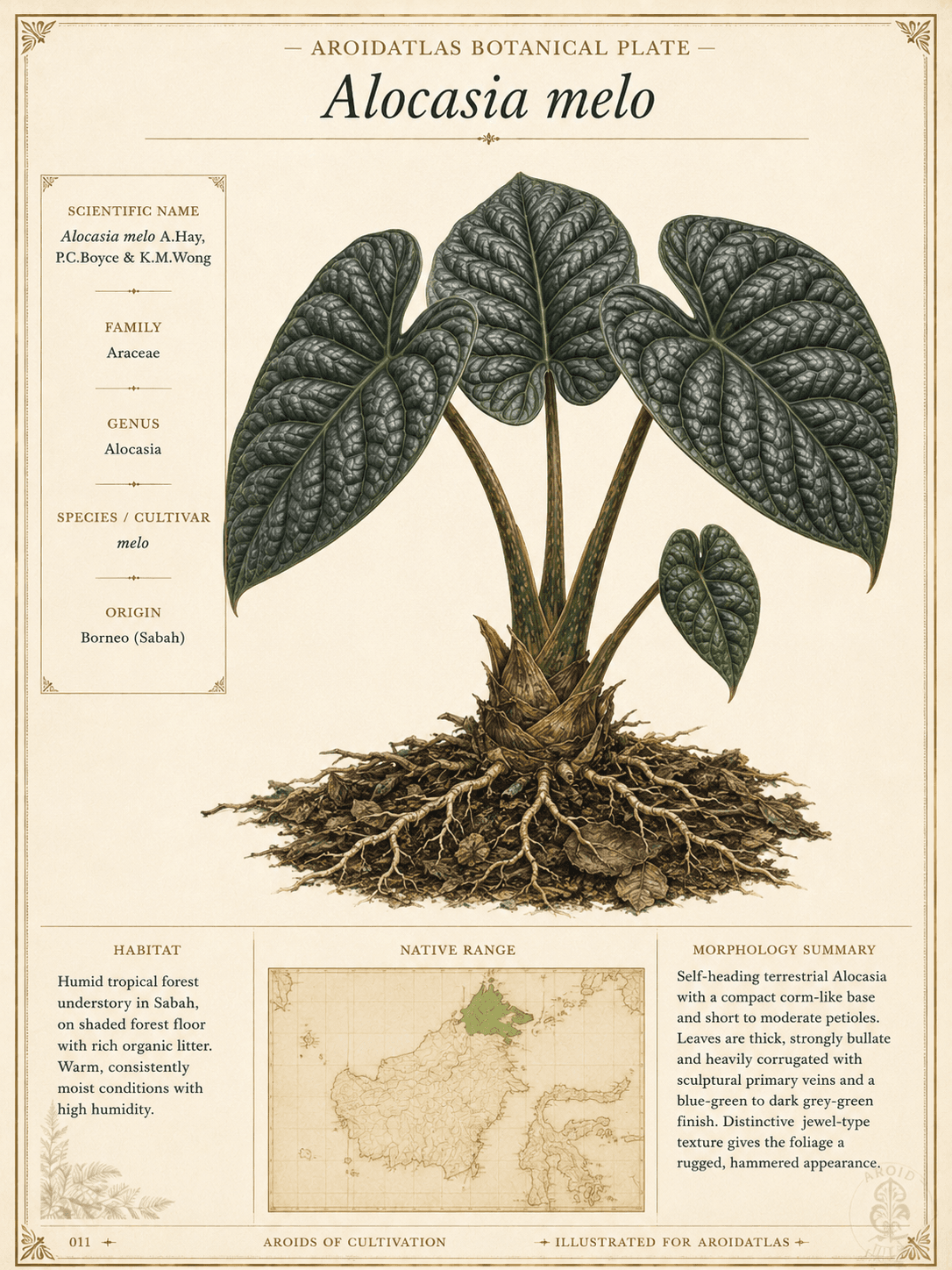
Alocasia melo is a spectacular dwarf jewel Alocasia endemic to the Sabah region of Borneo, where it grows specifically in ultramafic soils on rocky forest slopes. It is famous for its extremely thick, almost cardboard-like leaves with a deeply rugose, brain-like texture and a dark bluish-green to grey-green coloration. The leaves form a compact, low-growing rosette. Due to its specific native habitat, it requires excellent drainage and careful watering, but rewards growers with its unmatched sculptural beauty.
Climate Profile
Market Analysis & Price Guide
Historical auction metrics and live online retailer listings updated weekly.
How prices are calculated: The AA Price uses verified eBay UK completed auction data — we take the trimmed mean (removing the top and bottom 20% of prices) to produce a fair-value guide that excludes outlier sales. When recent auction data is unavailable, the AA Price falls back to the current UK retail average from tracked stockists. Retail prices are scraped from active UK plant shop listings and reflect what you would pay buying directly from a retailer today. All prices are in GBP and updated automatically.
No eBay auction history available yet for this plant. Data is collected automatically as sales appear on eBay UK.
Borneo's Cardboard Curiosity
Right then, kettle's on. A spot of tea always helps when contemplating Alocasia melo, the 'Rugosa Jewel.' This Borneo chap, formally described not long ago, hails from Sabah’s rocky, ultramafic slopes, making it a truly singular specimen. Its leaves are an utter marvel – so thick they feel like cardboard, deeply rugose, like a miniature brain sculpted from dark bluish-green leather. Absolutely no variegation, mind you, just that stunning texture. A proper dwarf rosette, it demands excellent drainage, a nod to its native habitat. Watering needs to be carefull, naturally. A bit fussy, perhaps, but the sculptural beauty it brings to the glasshouse makes the endeavour entirely worthwhile. One rather forgets the price paid for such a distinctive chunk of flora.