Alocasia infernalis
Alocasia Infernalis
Morphology
About
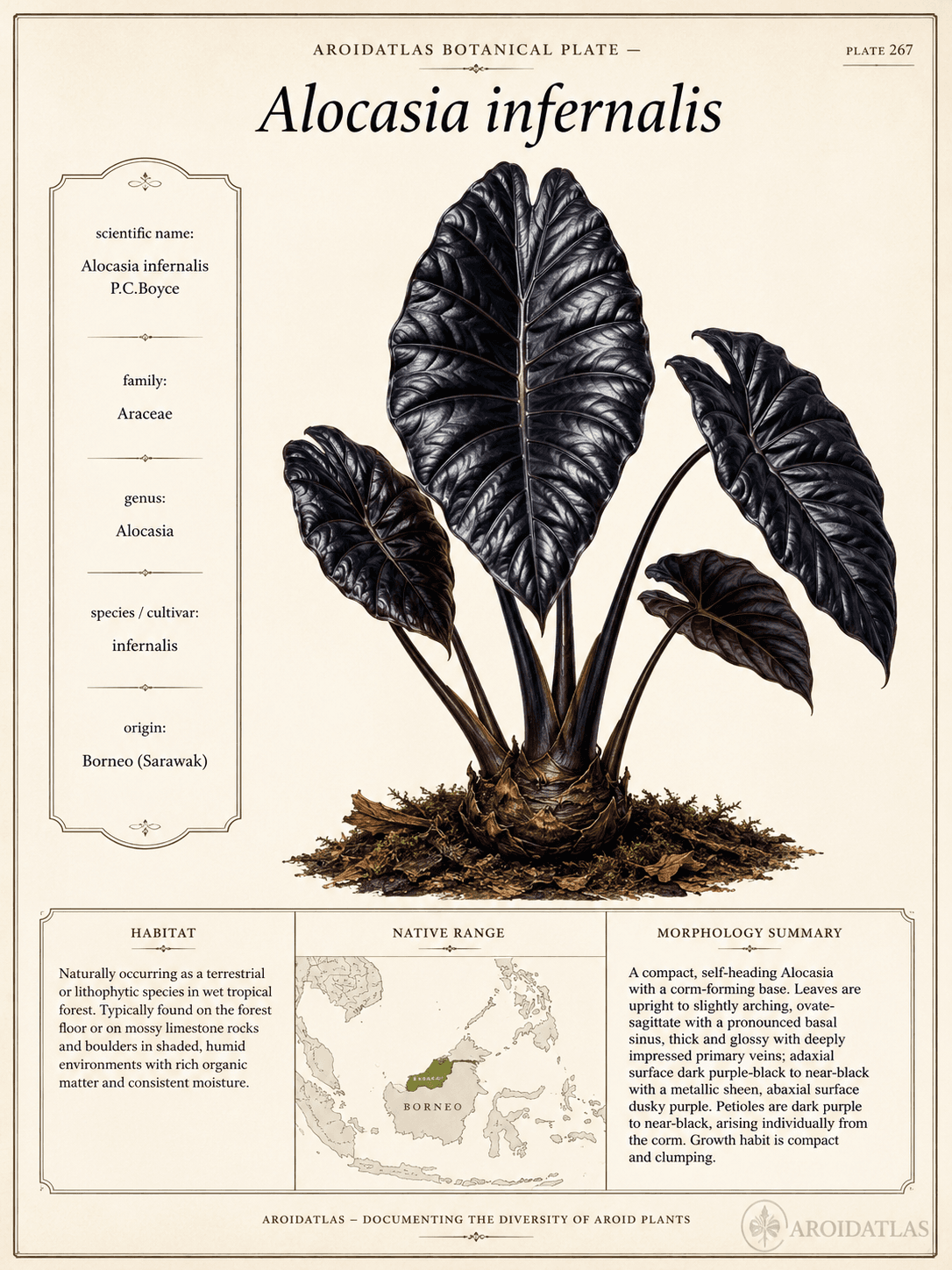
Native to Borneo (Sarawak), Alocasia infernalis thrives as a terrestrial or lithophytic species in wet tropical forests. It prefers shaded, humid environments with rich organic matter and consistent moisture, typically found on the forest floor or on mossy limestone rocks. This compact, self-heading Alocasia is characterized by its corm-forming base and clumping growth habit. Its thick, glossy, ovate-sagittate leaves display a striking dark purple-black to near-black adaxial surface with a metallic sheen, complemented by a dusky purple abaxial surface and deeply impressed primary veins. Dark purple to near-black petioles arise individually from the corm.
Climate Profile
Market Analysis & Price Guide
Historical auction metrics and live online retailer listings updated weekly.
How prices are calculated: The AA Price uses verified eBay UK completed auction data — we take the trimmed mean (removing the top and bottom 20% of prices) to produce a fair-value guide that excludes outlier sales. When recent auction data is unavailable, the AA Price falls back to the current UK retail average from tracked stockists. Retail prices are scraped from active UK plant shop listings and reflect what you would pay buying directly from a retailer today. All prices are in GBP and updated automatically.
No eBay auction history available yet for this plant. Data is collected automatically as sales appear on eBay UK.
A Spot of Infernal Beauty from Borneo
One rather does wonder if the naming of *Alocasia infernalis* P.C.Boyce wasn't a nod to the sheer effort involved in locating it, rather than just its appearance. Hailing from the shaded, humid undergrowth of Borneo’s Sarawak forests, often clinging to mossy limestone, this compact little corm-former certainly lives up to its 'dark' moniker. Its thick, glossy leaves, a magnificent ovate-sagittate form, are a startling near-black with a metallic sheen on top, a dusky purple underneath, and veins so deeply impressed they almost beg you to trace them. A splendid specimen, albeit one that makes my glasshouse feel positively tropical, even on a chilly British afternoon. Trying to propogate these beauties without proper humidity is a fool's errand. Still, a good cup of Darjeeling makes any botanical challenge a bit more manageable.